Why More Sales Is Not Always the Answer

Executive Summary
Most businesses don't have a sales problem. They have a commercial foundations problem.
When growth slows, the instinct is usually to generate more leads or hire another salesperson. Sometimes that's exactly the right decision, but when positioning, pricing, cash flow, delivery capacity or customer retention are weak, more sales often magnify the problem rather than solve it.
This Commercial Insight explains why sustainable growth starts with stronger commercial foundations, not simply more activity.
The Six Foundations of Sustainable Commercial Growth
When growth slows, the instinct is usually to generate more leads. Sometimes that is exactly what the business needs. But when positioning, margins, cash flow, delivery capacity or customer retention are weak, more sales can magnify the problem rather than solve it. The first task is diagnosis.
The Sales Trap
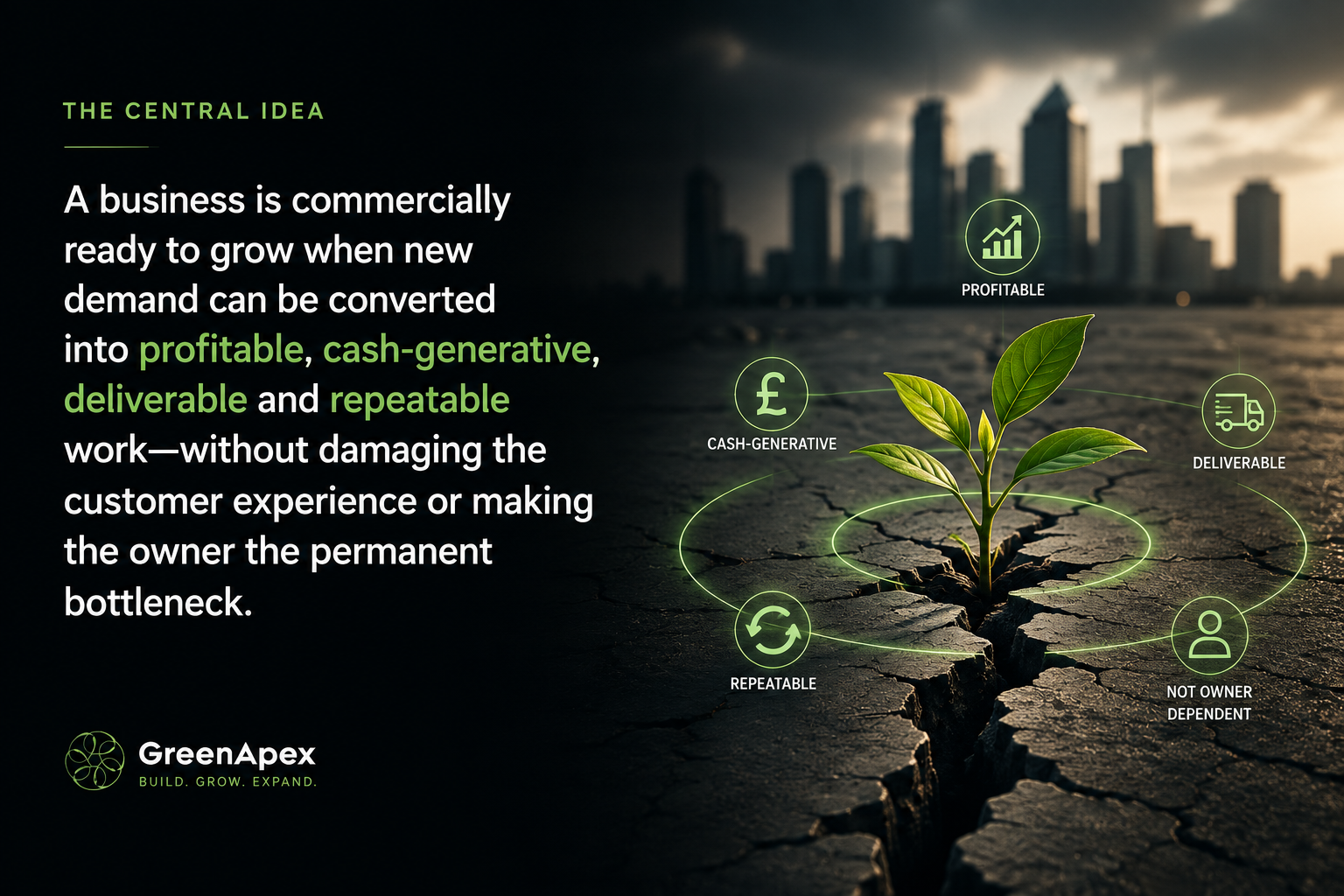
Sales matters. Without customers, there is no business. But revenue is an outcome, not a complete diagnosis of commercial health. When a business wants to grow, the most visible answer is often to increase activity: spend more on marketing, post more content, attend more events, hire a salesperson or ask the team to make more calls. Those actions can work. The risk is assuming that a lack of activity is the only possible constraint. A business may already have enough demand but convert it poorly. It may win work at the wrong price, serve customers who are expensive to support, invoice too slowly, depend too heavily on one channel, or lack the capacity to deliver consistently. In those situations, adding more leads does not remove the weakness. It feeds it.
That is why the better first question is not simply, “How do we sell more?” It is, “What is currently limiting profitable and sustainable growth?”
Revenue Growth Isn't Always Commercial Growth
Turnover can rise while the underlying business becomes weaker. A larger order book can hide falling margins, delayed payments, overworked staff, inconsistent delivery or a growing dependence on the owner. The headline number looks positive, but the quality of the growth is poor.
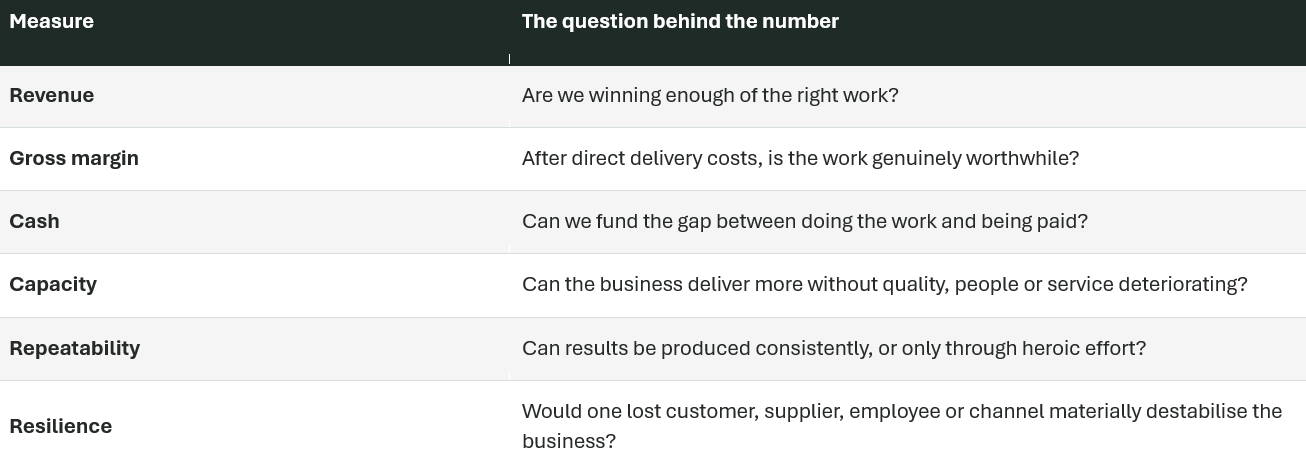
GreenApex uses the following as a practical working definition: commercial growth should improve more than revenue. It should strengthen the economics, cash position, delivery capability and future resilience of the business.
An illustrative example
Imagine two companies each win an additional £100,000 of annual revenue. Company A protects its margin, takes a deposit, has spare delivery capacity and has a clear process for turning the first project into repeat work. Company B discounts heavily, must hire subcontractors at short notice, accepts long payment terms and absorbs repeated changes that were never included in the original scope.
Both companies can report the same increase in turnover. Commercially, the outcomes are completely different. One has created value; the other may have created pressure. The example is illustrative, not a benchmark, but the principle is fundamental: the quality of revenue matters.
The Six Foundations of Commercial Growth
A business does not need to be perfect across every area before it grows. It does need enough alignment between the areas that create demand, convert demand and deliver the promise. GreenApex assesses that alignment through six connected foundations.
1. Commercial Strategy
Commercial strategy defines where the business is going, which opportunities it will pursue and which it will deliberately ignore. It connects ambition to the economics and capabilities of the business.
• A clearly defined target customer and priority market
• Specific commercial objectives with realistic timeframes
• An understanding of revenue, margin, cash and capacity implications
• Clear choices about products, services, channels and investment
• Named owners, measures and review points
Key question: Do we have a clear route to the result, or only a target?
2. Market Position & Brand
Positioning is the place a business occupies in the customer’s mind. Brand supports that position, but it is not limited to a logo, website or colour palette. It includes the promise the business makes, the evidence behind it and the consistency with which it is experienced.
• A specific problem the business is best placed to solve
• A value proposition that is meaningful to the customer
• Clear differentiation that is more credible than “quality service”
• Proof through results, expertise, process, case studies or guarantees
• Pricing and messaging that reinforce the intended position
Key question: Can the right customer quickly understand why they should choose us?
3. Sales & Business Development
Sales and business development turn market opportunity into qualified conversations, proposals and customers. This foundation is not simply about volume. It is about building a process that can be measured, improved and repeated.
• A defined route from lead generation to close
• Consistent qualification criteria
• A realistic pipeline with clear stages and next actions
• Conversion, sales-cycle and source data that inform decisions
• Follow-up discipline and clear responsibility
• A CRM that supports the process rather than becoming an administrative burden
Key question: Can we explain how opportunities are created, progressed and won?
4. Customer Experience
Growth does not end when a customer says yes. Onboarding, communication, delivery and aftercare determine whether the promise is kept. They also affect retention, referrals, reputation and the true cost of serving the customer.
• Clear expectations before work begins
• A consistent onboarding and communication process
• Feedback gathered early enough to act on it
• A deliberate approach to retention, repeat business and referrals
• A way to identify where service failures or scope disputes originate
Key question: Does the experience make customers more likely to stay, buy again and recommend us?
5. Commercial Operations
Commercial operations connect the front of the business to delivery. This is where pricing, forecasting, capacity, invoicing, responsibilities and performance information come together.
• Pricing that reflects delivery cost, value and risk
• Visibility of margin by product, service, project or customer where practical
• Capacity planning before new work is committed
• Prompt invoicing, sensible payment terms and active debtor management
• Documented core processes and clear decision rights
• A small set of useful performance measures
Key question: Can we deliver growth without losing control of margin, cash or quality?
6. Technology & AI
Technology should remove friction, improve decisions or create a better customer experience. It should not be adopted simply because it is fashionable. AI has real potential, but its value depends on a clear use case, suitable data, responsible oversight and a process worth improving.
• A defined commercial problem before a tool is selected
• Simple, reliable systems that people will actually use
• Appropriate data quality, access controls and human review
• Automation focused on repetitive, low-value work
• Measures that show whether time, cost, quality or conversion has improved
Key question: Is technology solving a real constraint, or adding another layer of complexity?
How Commercial Problems Disguise Themselves as Sales Problems
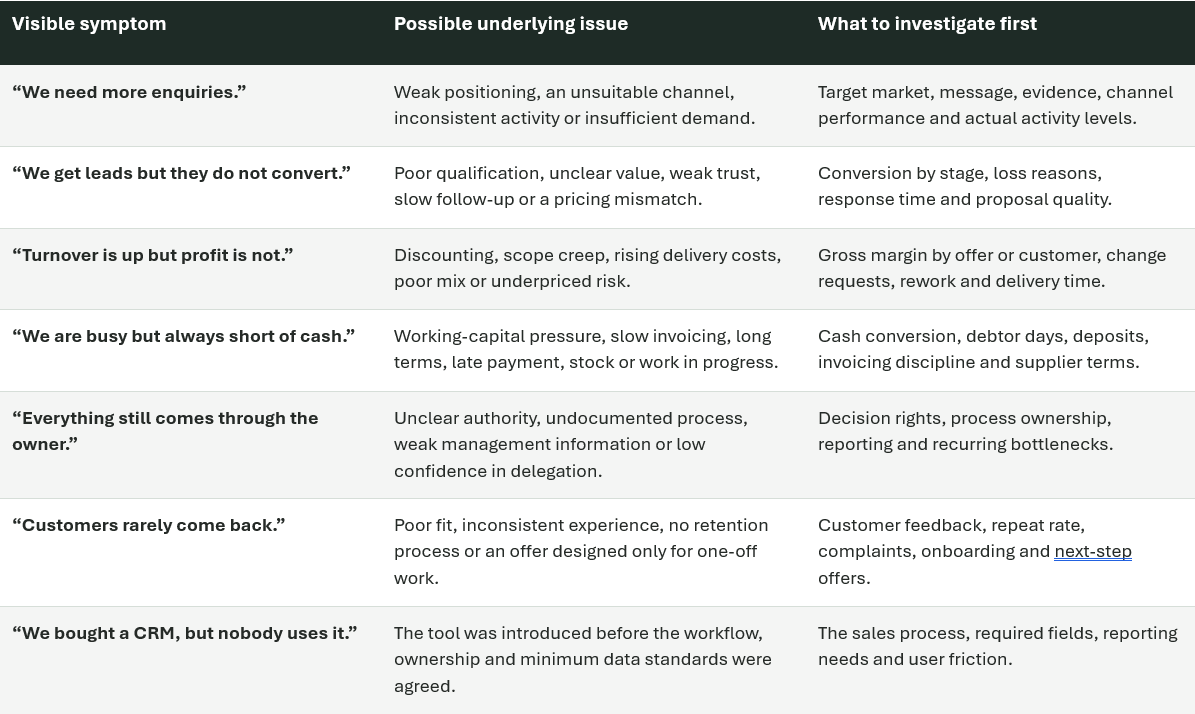
The symptom is not always the cause. The table below is not a substitute for diagnosis, but it shows why increasing sales activity without examining the wider system can be expensive.
What the Evidence Tells Us - And What it Does Not
At the start of 2025, the UK had an estimated 5.7 million private-sector businesses. SMEs represented 99.85% of that population, and 4.3 million businesses had no employees other than their owners. This does not mean owner-led businesses are inherently weak. It does show why the owner’s commercial decisions, time and capacity are so influential in a large part of the economy. [1]
The Office for National Statistics has also found that structured management practices are associated with higher productivity and resilience. Its measures include continuous improvement, key performance indicators, targets and people management. The important limitation is that the 2023 survey covered businesses with at least 10 employees in selected production and service industries. It supports the value of disciplined management, but it should not be presented as direct evidence about every micro business or as proof that one practice alone causes growth. [2]
Cash deserves equal attention. The British Business Bank’s 2026 review reported increased use of flexible finance to support cash flows during 2025, while the Office of the Small Business Commissioner estimates that late payments cost the UK economy £11 billion each year and consume substantial management time. The commercial lesson is not that borrowing is good or bad. It is that profitable work can still create strain when the timing of cash in and cash out is poorly managed. [3][4]
Evidence standard: Good commercial advice separates data, interpretation and judgement. Statistics can highlight patterns, but they do not diagnose an individual business. The correct action depends on the business model, stage, market, economics and objectives.
A Practical Commercial-Readiness Check
Before investing more time or money into growth, a business owner or leadership team should be able to answer the following questions with evidence rather than instinct. This is a discussion tool, not a validated scorecard.
□ Which customer segment are we prioritising, and which are we not?
□ What commercial problem do we solve, and why is our solution credible?
□ Which products, services or customer types generate the strongest contribution - not just the most revenue?
□ How many qualified opportunities are in the pipeline, and what is the realistic value and timing?
□ Where do prospects drop out of the sales process, and why?
□ How much cash and delivery capacity would be required if sales increased by 20%?
□ Which parts of delivery currently depend on one person?
□ How consistently do customers receive the experience we promise?
□ What proportion of revenue comes from repeat business, referrals or a single customer?
□ Which five measures would tell us early that performance is improving or deteriorating?
□ Which manual tasks should be simplified before they are automated?
□ What is the single most important commercial constraint to solve in the next 90 days?
A “no”, “we do not know” or “it depends” is not a failure. It is a signal that the next investment should begin with clarification rather than acceleration.
A 30-day commercial reset
A full transformation is rarely the right first move. A disciplined month can create enough clarity to stop wasted activity and identify the most valuable next action.
Week 1: Establish the baseline
Bring together the core facts: revenue, gross margin, cash position, overdue debt, pipeline, conversion, customer concentration, repeat business and current capacity. Use the best available information; do not wait for perfect data.
Week 2: Identify the constraint
Look for the issue that most limits the next stage of growth. It may be demand, but it may also be conversion, pricing, delivery, cash, retention, owner dependency or lack of focus. Choose one primary constraint, not ten priorities.
Week 3: Make one controlled intervention
Examples include narrowing the target customer, revising qualification questions, introducing a deposit, clarifying scope, simplifying the proposal, changing follow-up standards or documenting one critical process.
Week 4: Measure and decide
Review what changed. Did the intervention improve response time, conversion, margin, cash, capacity or customer experience? Keep it, adapt it or stop it. Then choose the next constraint.
The GreenApex perspective
GreenApex does not believe every business should pursue growth at any cost. Sometimes the commercially intelligent decision is to serve fewer customers better, remove an unprofitable offer, raise prices, tighten payment terms, improve retention or create enough operational control for the owner to step back.
Nor should a commercial review become a thick report that describes the business without changing it. Its purpose is to identify the most important constraints, set priorities, assign ownership and define how progress will be measured.
The six foundations are connected. Strong marketing cannot compensate indefinitely for a poor customer experience. A healthy pipeline cannot protect an underpriced offer. New technology cannot repair an unclear process. Operational discipline cannot create demand where the market proposition is weak.
No business needs equal maturity in every area. A start-up, an established local business and an international scale-up face different risks. The objective is not perfection. It is commercial readiness for the next stage.
Before asking, “How do we sell more?”, ask this:
If we win more work tomorrow, will it improve profit, cash, customer experience and the strength of the business?
Clear answer: accelerate. Unclear answer: diagnose first.
Final Thought
Before investing more money into marketing or sales, ask yourself one question:
If we doubled demand tomorrow, would the business become stronger or simply busier?
The answer to that question often determines whether growth becomes sustainable or stressful.
About GreenApex
GreenApex helps founders, micro businesses and SMEs build stronger commercial foundations through practical strategy, business development and structured commercial reviews.
If you're unsure where your greatest commercial opportunity or constraint lies, our Commercial Business Review™ provides an independent assessment with clear, practical recommendations.
Sources and research notes
[1] Department for Business and Trade, Business population estimates for the UK and regions 2025, published 2 October 2025. View official statistics
[2] Office for National Statistics, Management practices in the UK: 2016 to 2023, published 13 May 2024. The survey covers firms with at least 10 employees in selected industries and reports associations rather than proving causation. View ONS bulletin
[3] British Business Bank, Small Business Finance Markets Report 2026, published 17 March 2026. View report
[4] Office of the Small Business Commissioner, official guidance and statistics on late payment, accessed 3 August 2026. View official source
Research note: Figures reflect the latest official sources identified at the publication date. Some datasets are estimates or official statistics in development and may be revised. The article distinguishes source findings from GreenApex interpretation and practical judgement.