The Commercial Leadership Gap: Why Growing Businesses Are Turning to Fractional Commercial Directors

Why SMEs may need senior commercial leadership long before a full-time director makes commercial sense.
Growing businesses often reach an awkward stage. They have moved beyond simple founder-led selling, but they are not yet large enough to justify a full senior commercial team. Sales, marketing, partnerships and expansion are all happening, yet responsibility for connecting them still sits with the founder or Managing Director. That is where the idea of fractional commercial leadership becomes relevant.
What does “fractional” actually mean?
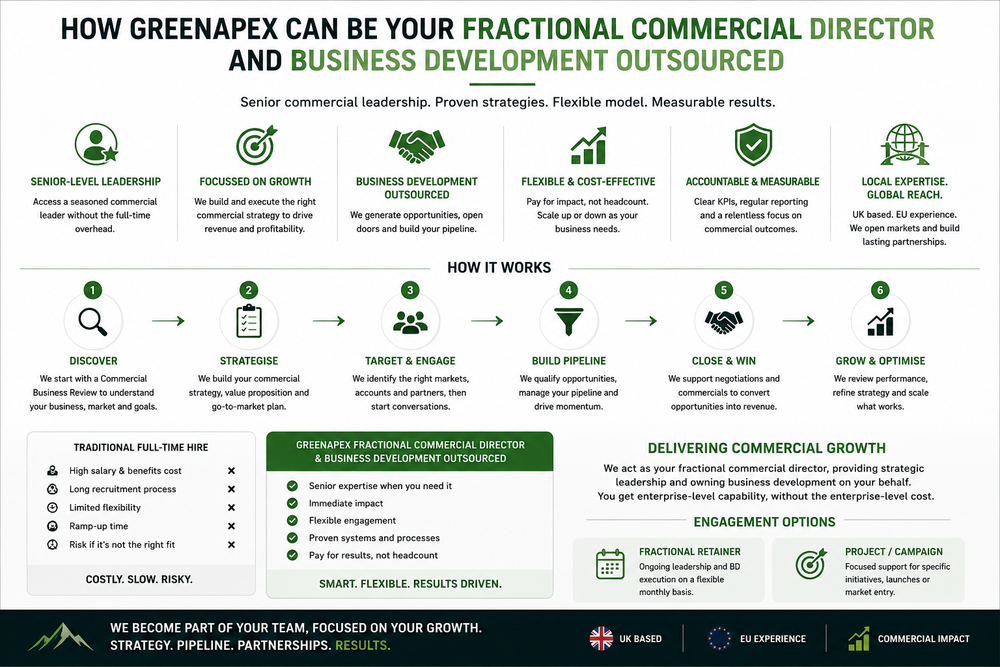
A Fractional Commercial Director is an experienced senior commercial leader who works with a business on a part-time or retained basis. They provide the strategic direction, leadership and hands-on commercial support associated with a director-level role without being employed full-time. In simple terms, the business gets access to senior commercial capability for the time it actually needs it.
THE CENTRAL IDEA
A business can outgrow founder-led commercial decision-making before it has enough work or budget for a permanent Commercial Director. Fractional leadership can close that gap by providing senior capability at the level and frequency the business actually needs.
The commercial leadership gap
Most companies do not wake up one morning and decide they need a Commercial Director. The need develops gradually. A founder wins the first customers. Referrals create momentum. Marketing activity begins. A salesperson may be hired. A CRM is introduced. New sectors, partnerships and geographic markets start to look attractive. Individually, each step can be positive. Together, they create commercial complexity.
Eventually the business has plenty of commercial activity, but no single person is taking responsibility for the whole picture. Who decides which customer segments matter most? Who challenges pricing and margin? Who owns the sales forecast? Who makes sure marketing is supporting the sales strategy? Who determines whether a new market is genuinely attractive or simply interesting? Who decides what should not be pursued?
In a larger organisation, those questions are distributed across experienced commercial leadership. In a growing SME, they frequently return to the founder or Managing Director. GreenApex refers to this point as the Commercial Leadership Gap: the stage where the business has become too commercially complex to be led reactively, but has not yet reached the scale where a complete senior commercial structure makes economic sense.
Why this matters in the UK SME economy
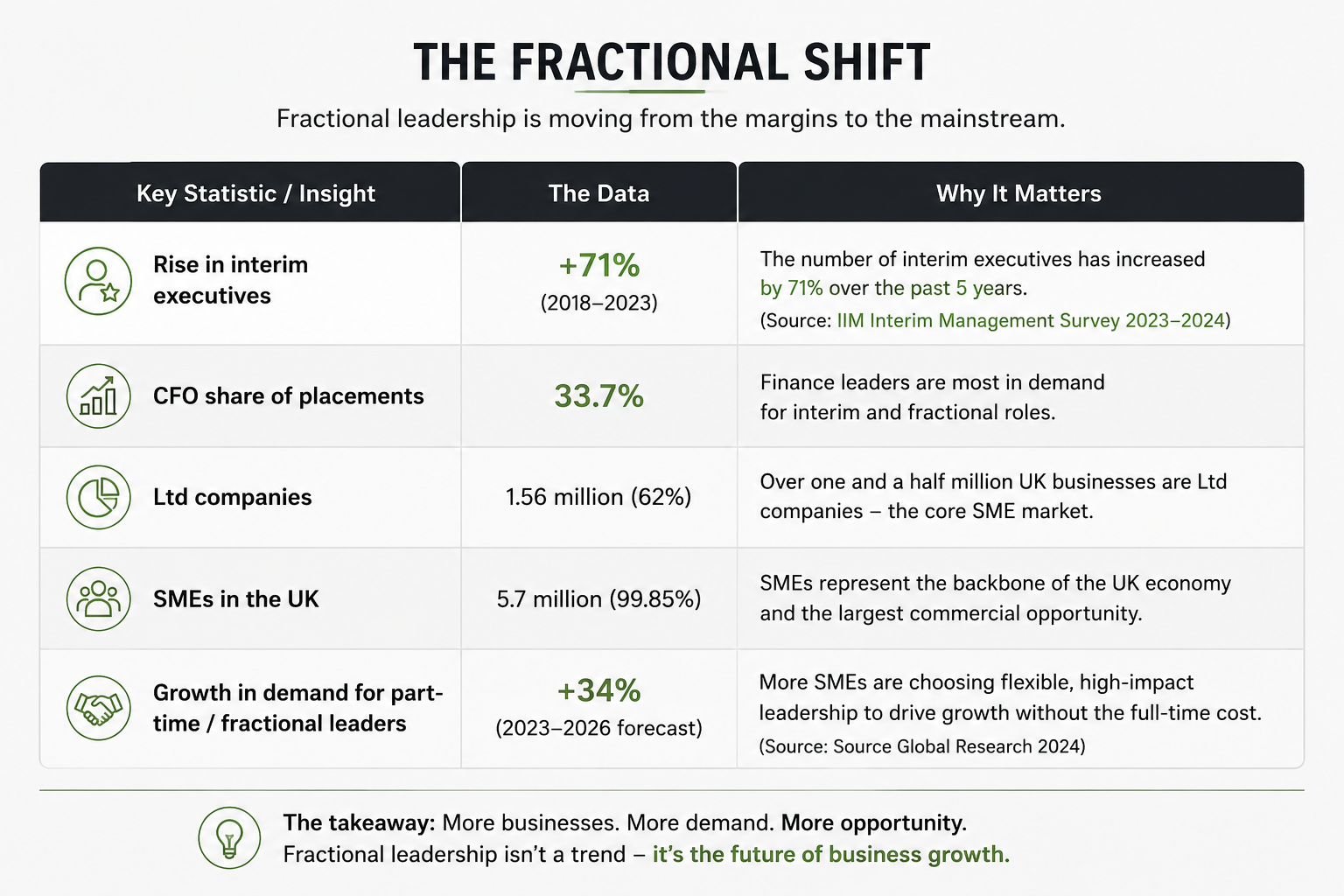
The scale of the issue is easy to underestimate. At the start of 2025, the UK had an estimated 5.7 million private-sector businesses. SMEs accounted for 99.85% of that population, employed 16.9 million people - around 60% of private-sector employment - and generated an estimated £2.8 trillion of turnover, or 51% of the private-sector total. [1]
Why this matters in the UK SME economy
The scale of the issue is easy to underestimate. At the start of 2025, the UK had an estimated 5.7 million private-sector businesses. SMEs accounted for 99.85% of that population, employed 16.9 million people - around 60% of private-sector employment - and generated an estimated £2.8 trillion of turnover, or 51% of the private-sector total. [1]
These figures do not mean that every small company needs a fractional director. Most do not. They do show the structural reality: a huge part of the UK economy is run without the layered leadership teams available to large organisations. Senior decisions still need to be made, but the capacity to specialise is much thinner.
The business has outgrown founder-led sales - but not the founder
Founder-led sales can be one of the strongest assets in an early-stage business. The founder understands the product, knows the customer problem, carries credibility and can often sell with an energy that is difficult to replicate. The problem is not founder involvement. The problem appears when almost every important commercial decision still depends on the founder after the business has become materially more complex.
The same person who once spent most of the week building relationships may now be responsible for recruitment, operations, suppliers, finance, people issues and strategic decisions. Commercial development starts happening between everything else. A distributor approaches, so somebody investigates it. A competitor enters a new market, so expansion suddenly becomes urgent. Sales ask for more leads, so marketing launches a campaign. A new piece of software is bought. A new salesperson joins and asks which sectors to prioritise.
Everyone can be busy while the business remains directionally unclear. Activity increases, but priorities are constantly being reset. Opportunities are pursued because they appear rather than because they fit a deliberate commercial strategy. That is often the first sign that the business needs more than additional sales capacity; it needs commercial leadership.
Why another salesperson may not solve the problem
One of the easiest mistakes at this stage is diagnosing a leadership problem as a sales-capacity problem. If the pipeline is inconsistent or the founder no longer has enough time to generate new business, hiring another salesperson can feel like the obvious answer. Sometimes it is the right answer. But a salesperson primarily adds execution capacity. They do not automatically provide the strategic decisions that make that activity effective.
Before increasing activity, somebody still needs to answer: What should we sell? To whom? At what margin? Through which channels? In which markets? With what proposition? How should opportunities be qualified? What should the business stop doing? What does realistic growth look like over the next 12 to 36 months?
If those questions remain unresolved, the business can simply create more activity around an unclear strategy. This is closely connected to the argument in GreenApex’s first Commercial Insight, “Why More Sales Is Not Always the Answer”: increasing sales activity does not correct weak positioning, poor economics or an unclear route to market. It can magnify them.
Fractional leadership is moving into the mainstream
Fractional leadership is not new, but its visibility has increased rapidly. The model is already well established in finance, where Fractional Finance Directors and CFOs work with businesses that need senior financial leadership without a full-time appointment. The CFO Centre, for example, now describes a network of more than 750 fractional CFOs across 18 countries. [2]
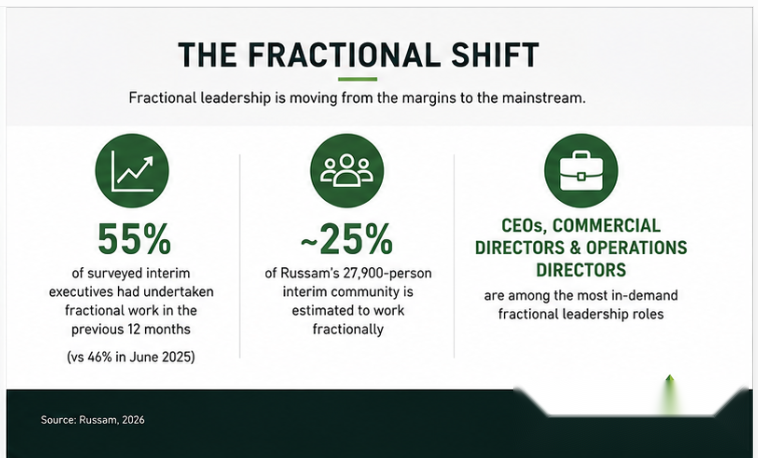
The model is also spreading beyond finance. In a 2026 poll of its interim and executive community, Russam reported that 55% of respondents had undertaken a fractional role in the previous 12 months, up from 46% in June 2025. Russam estimates that around 25% of its 27,900-person interim community is now working fractionally and says demand is extending to CEOs, Commercial Directors, Operations Directors and transformation specialists. [3]
WHAT THE TREND SUGGESTS
Businesses are beginning to separate access to senior capability from the traditional requirement to employ that capability full-time.
Russam’s figures come from its own executive community and should not be treated as a measure of the entire UK labour market. They are still useful evidence of a changing leadership model within the part of the market where interim and fractional work is already established. The direction is clear: more organisations are considering whether senior expertise needs to be owned permanently or accessed flexibly.
The economics are only part of the argument
The obvious attraction of fractional leadership is cost flexibility. A permanent senior commercial appointment brings salary, employer National Insurance, pension, bonus or commission, recruitment cost, equipment, benefits and the risk of making the wrong hire. For many growing SMEs, that is a substantial fixed commitment.
But reducing the argument to “fractional is cheaper” misses the point. The more useful question is whether the business currently has enough director-level commercial work to justify a full-time appointment. A company may genuinely need experienced leadership for strategy, pipeline governance, pricing, market development and sales management, while having no sensible use for that person five days every week.
Fractional leadership therefore changes the buying decision. Instead of asking “Can we afford another director?”, the business can ask “What level of commercial leadership do we actually need right now?” The answer might be one day a week, several days each month, a retained role around agreed outcomes, or a defined period during market entry or transformation.
A USEFUL PRINCIPLE
The business buys the level of capability it needs, in the quantity it currently needs it.
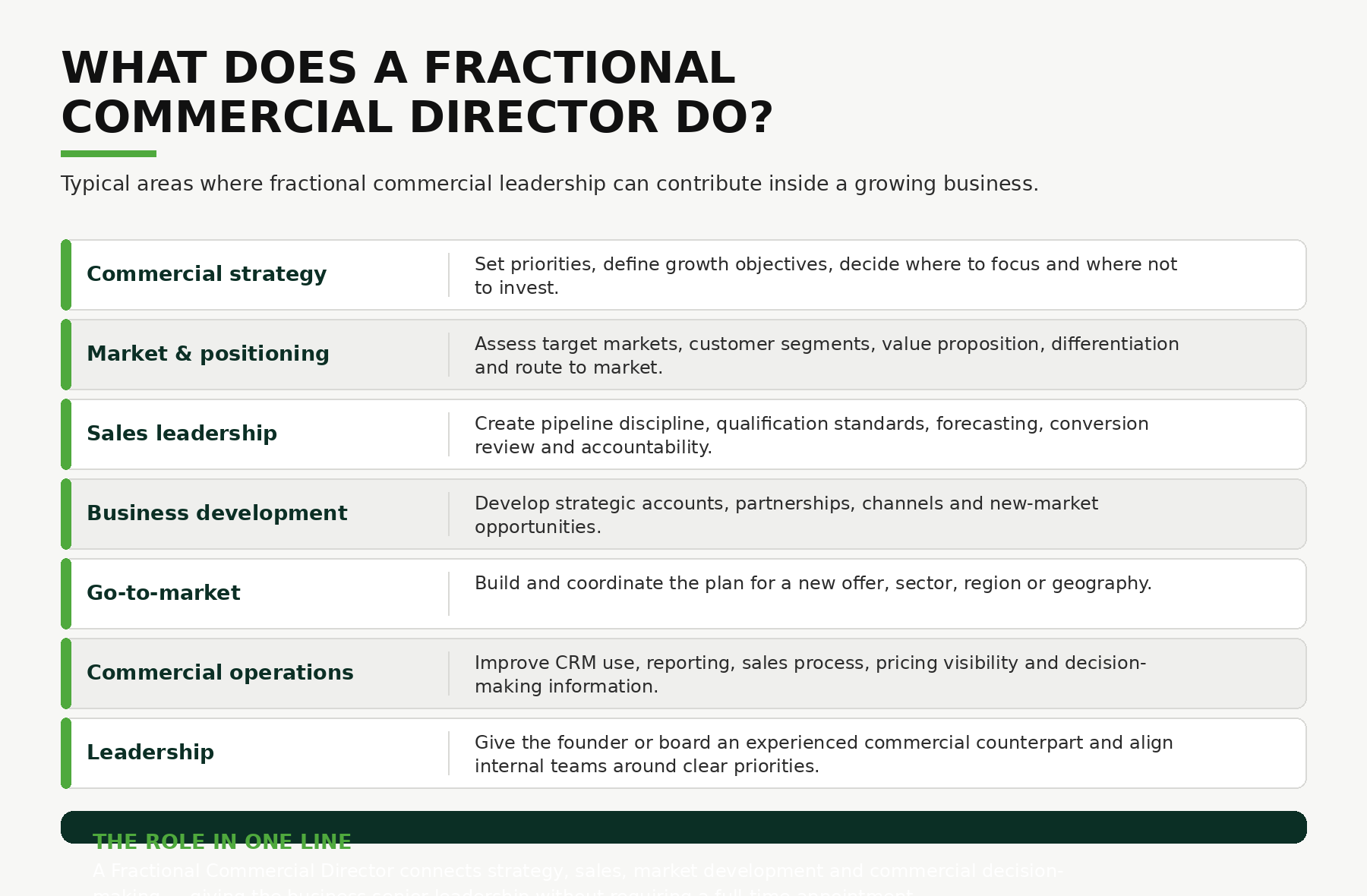
What does a Fractional Commercial Director actually do?
A Fractional Commercial Director should not simply be a salesperson with a more senior title. The role is broader: understanding how the business creates commercial value, defining priorities and helping the organisation execute them consistently. The exact scope varies, but it often connects several areas that otherwise sit in separate silos.
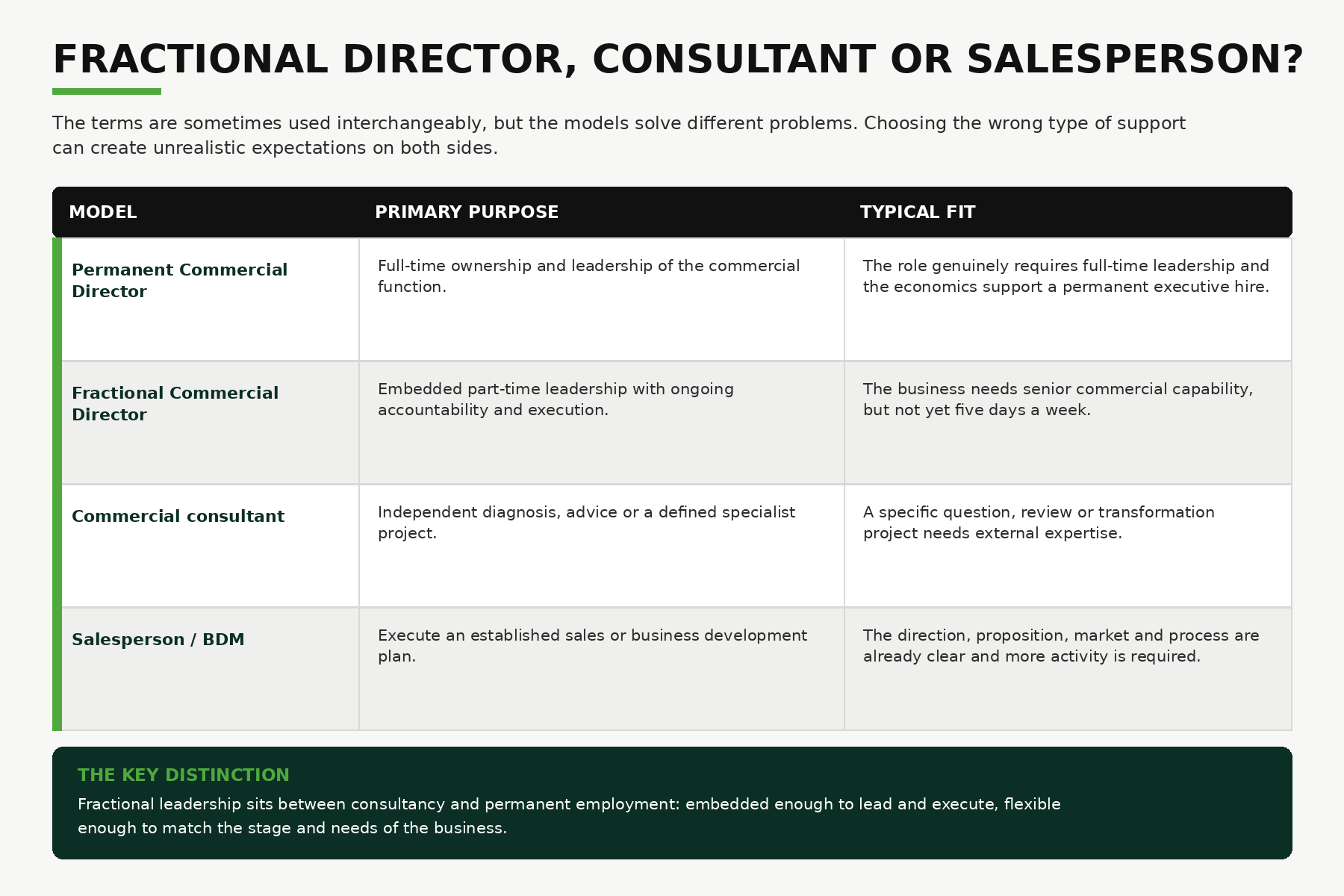
None of these models is inherently better than another. The correct choice depends on the problem. A company with a clear market, strong positioning and an established sales process may simply need another capable salesperson. A company struggling to decide where growth should come from probably needs leadership before it adds headcount.
Structured management is harder to build in smaller organisations
There is a broader management issue behind the fractional trend. The Office for National Statistics measures structured management practices such as continuous improvement, the use of key performance indicators, target setting and people management. In its 2023 survey, the average management-practice score increased to 0.57 from 0.51 in 2020, and the ONS notes that stronger management practices are associated with higher productivity and resilience. [4]
Firm size matters. Even after controlling for other business characteristics, larger firms in the ONS sample had management scores 0.13 points higher than the smallest firms. The survey covered firms with at least 10 employees in selected production and service industries, so it should not be presented as proof about every microbusiness. But it supports an intuitive point: larger organisations have more capacity to formalise management, measurement and specialist leadership.
A £100 million organisation can employ separate leaders for finance, sales, marketing, operations, HR and strategy. A £2 million business may have a Managing Director and a small management team making decisions across all of those areas. The decisions do not disappear because the company is smaller; they simply become concentrated among fewer people.
Fractional leadership offers one way of reducing that structural disadvantage. Rather than attempting to recreate an entire corporate leadership team, an SME can selectively access experienced leadership in the areas where the next stage of growth creates the greatest need.
When fractional commercial leadership works best
Fractional support is most useful when there is a genuine leadership problem to solve, clear access to the founder or board, enough information to make decisions and a willingness to act on those decisions. It is not a substitute for commitment inside the business.
• Revenue has grown, but the commercial structure has not kept pace.
• The founder or Managing Director remains involved in nearly every significant opportunity.
• Salespeople are present, but nobody is genuinely leading the commercial function.
• Marketing and sales operate independently with weak shared priorities or reporting.
• Pipeline forecasting is unreliable or largely based on intuition.
• Growth has plateaued despite continued sales and marketing activity.
• The business wants to enter a new sector, channel or geographic market.
• Important commercial opportunities exist, but nobody senior has the capacity to own them.
• The company needs director-level commercial expertise but cannot justify a permanent appointment.
• There is plenty of activity, but no clearly defined commercial plan.
The common thread is not necessarily poor performance. Many companies reach this point precisely because they have grown successfully. The commercial structure simply has not evolved at the same speed as the business.
When it is the wrong solution
Fractional leadership is not automatically the answer. A very early business may still be best served by the founder directly leading commercial activity. A larger company with a sizeable sales and marketing function may genuinely need a permanent Commercial Director. And a company with no product-market fit, no resources to execute, or no willingness to change will not fix those problems by adding a fractional title.
There is also a risk of using “fractional” as a fashionable label for ordinary freelance work. A genuine fractional leader should have defined responsibilities, decision rights, objectives and a level of accountability that goes beyond delivering isolated tasks. The fact that somebody works fewer days does not mean they should be only partially committed to the outcome.
Fractional should not mean partially committed
The word “fractional” describes the proportion of time, not the proportion of responsibility. Russam distinguishes fractional leadership from traditional interim management by describing it as typically longer-term, part-time, strategically focused and common within SMEs, scale-ups and founder-led businesses. [3]
For the model to work, the leader needs enough continuity to learn the business, understand the customers, build trust with the team and see decisions through. That usually means a retained relationship rather than a sequence of disconnected days. The role should also have visible measures: pipeline quality, conversion, target-account progress, market-entry milestones, channel development, forecasting accuracy or other commercial outcomes that fit the business.
The GreenApex perspective
GreenApex does not believe fractional leadership should be sold as a cheaper version of a permanent director. That framing undervalues the model and encourages the wrong buying decision. The purpose is to give a business access to the right level of capability at the stage where it creates value.
The same principle applies to business development outsourcing. External support is most effective when it is connected to the wider commercial strategy rather than treated as a standalone lead-generation service. Market choice, positioning, sales process, pipeline discipline and execution need to reinforce one another.
For some businesses, the right answer will be a defined commercial project. For others, it will be a retained fractional relationship. And when the role becomes large enough to require permanent ownership, hiring a full-time Commercial Director may be exactly the right next step. A good fractional engagement should help the business become clearer about when that point has arrived.
Growing businesses are regularly told they need more leads, more salespeople, more marketing or more technology. Sometimes they do. But there comes a point where adding more commercial activity without somebody taking ownership of the wider picture creates complexity rather than sustainable growth.
The UK SME economy is enormous, yet most SMEs cannot justify the executive structure of a large organisation. Fractional leadership offers another route: access experience earlier, introduce commercial structure sooner and scale the level of leadership as the business develops.
Perhaps the question for a growing business is not “Can we afford a Commercial Director?” Perhaps it is “Can we afford to keep growing without commercial leadership?”
Sources and research notes
[1] Department for Business and Trade, Business population estimates for the UK and regions 2025, published 2 October 2025. View official statistics
[2] The CFO Centre UK, Fractional CFO Services UK, accessed 10 August 2026. Provider source used only as evidence of an established fractional finance model. View source
[3] Russam, Fractional Leadership Momentum Continues to Build, 2026. Polling relates to Russam’s own interim and executive community. View Russam research
[4] Office for National Statistics, Management practices in the UK: 2016 to 2023, published 13 May 2024. Survey covers firms with at least 10 employees in selected industries; association does not prove causation. View ONS bulletin
Research note: Statistics indicate patterns and market signals; they do not diagnose an individual business or prove that fractional leadership will improve performance. The right model depends on stage, economics, objectives, management capability and execution capacity.