AI is Making Bad Go-to-Market Strategies Faster.
AI can make sales and marketing faster, more informed and more efficient. But when the strategy underneath is weak, automation does not solve the problem - it simply scales it.
“In an AI-driven world, human judgement may become your greatest commercial advantage.”
AI-powered go-to-market has become one of the biggest commercial conversations of 2026. Looking across HubSpot's UNBOUND 2026 programme this month, one theme kept appearing: AI is moving deeper into how businesses attract, understand and convert customers - from search and content to buying signals, CRM and sales enablement.
Forrester's August research found that 88% of B2B marketing organisations had adopted AI tools or developed their own. Yet leaders still reported unclear strategy, difficulty measuring impact and weak data foundations. That gap matters. Businesses can now execute faster than ever, even when the commercial choices underneath the activity are still unclear.
That is the premise of this Insight. AI can increase output, improve research and make commercial teams more efficient, but it can also make a weak go-to-market strategy move faster. The question is not whether to use AI. It is whether the strategy deserves to be accelerated.
What UNBOUND 2026 is Really Telling Commercial Teams
HubSpot's State of HubSpot 2026 session described buyer journeys fragmented across AI, search, communities, outbound and inbound, with stronger organisations building signal-led revenue engines rather than relying on one tactic.
Elsewhere, the programme covered Answer Engine Optimisation, AI as a marketing channel, redesigned GTM engines and human-centred marketing. The message was broader than 'use more AI': AI is becoming part of discovery, research, content, prospecting, CRM and sales enablement.
That makes the underlying choices more important. Signals only help if you know which customers matter. Personalisation only works if positioning is relevant. Speed only helps if the opportunity is worth pursuing.
The Buying Journey Has Changed
The fundamentals of buying have not suddenly changed. Customers still want relevance, proof, trust, value and confidence. What has changed is the environment around them: more channels, more information and more AI-assisted ways to research, compare and validate suppliers before speaking to sales.
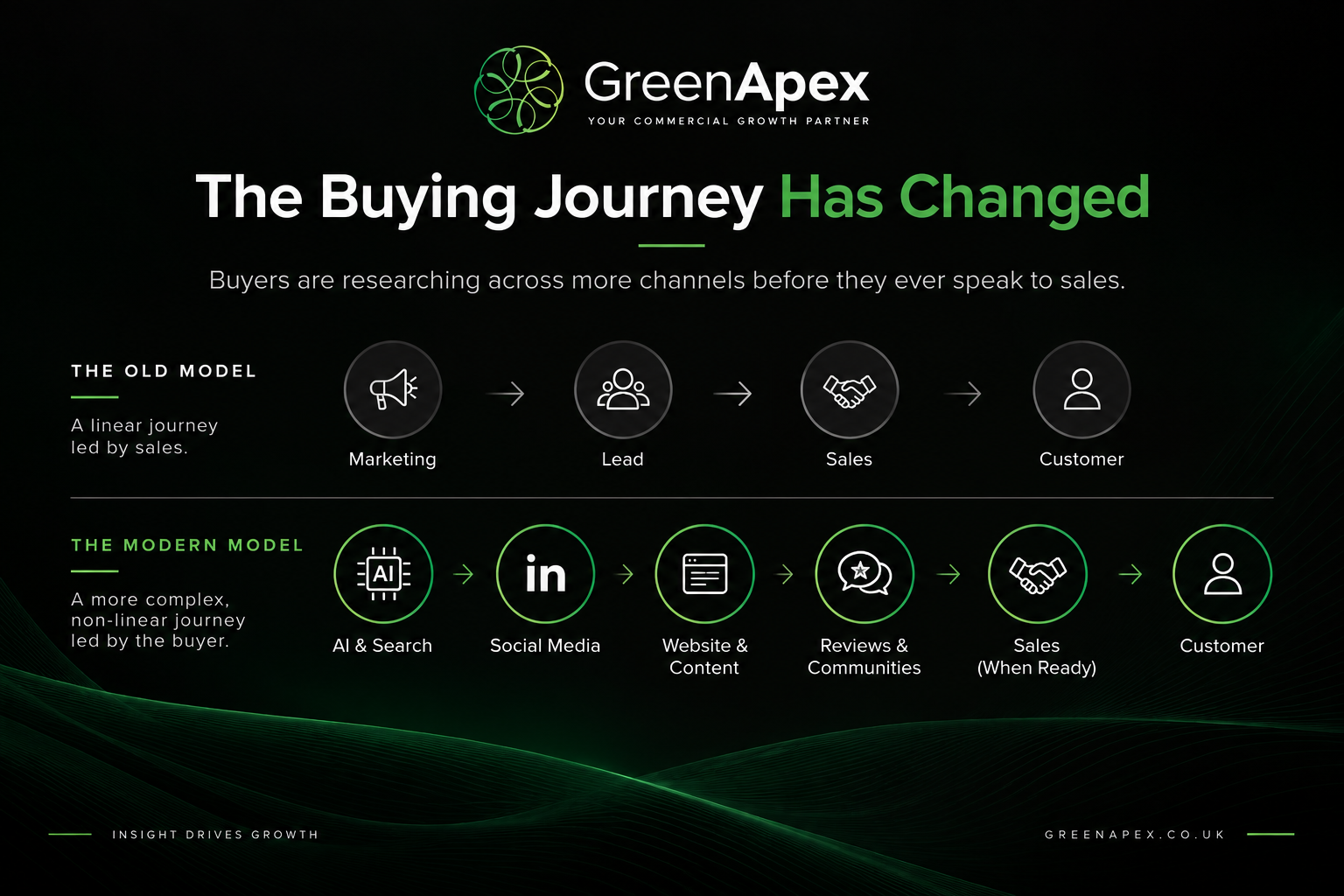
The modern buying journey is better understood as a network of discovery and validation points than a simple sales hand-off.
Gartner reported in May 2026 that 45% of B2B buyers in its survey had used generative AI during a recent purchase, mainly to gather information on vendors and products. Buyers used an average of seven information sources, yet 69% still preferred to validate AI-generated insights with a salesperson.
McKinsey's 2026 Global B2B Pulse, based on nearly 4,000 decision-makers across 13 countries, found buyers now use an average of ten channels across the purchasing journey and expect to move between them seamlessly.
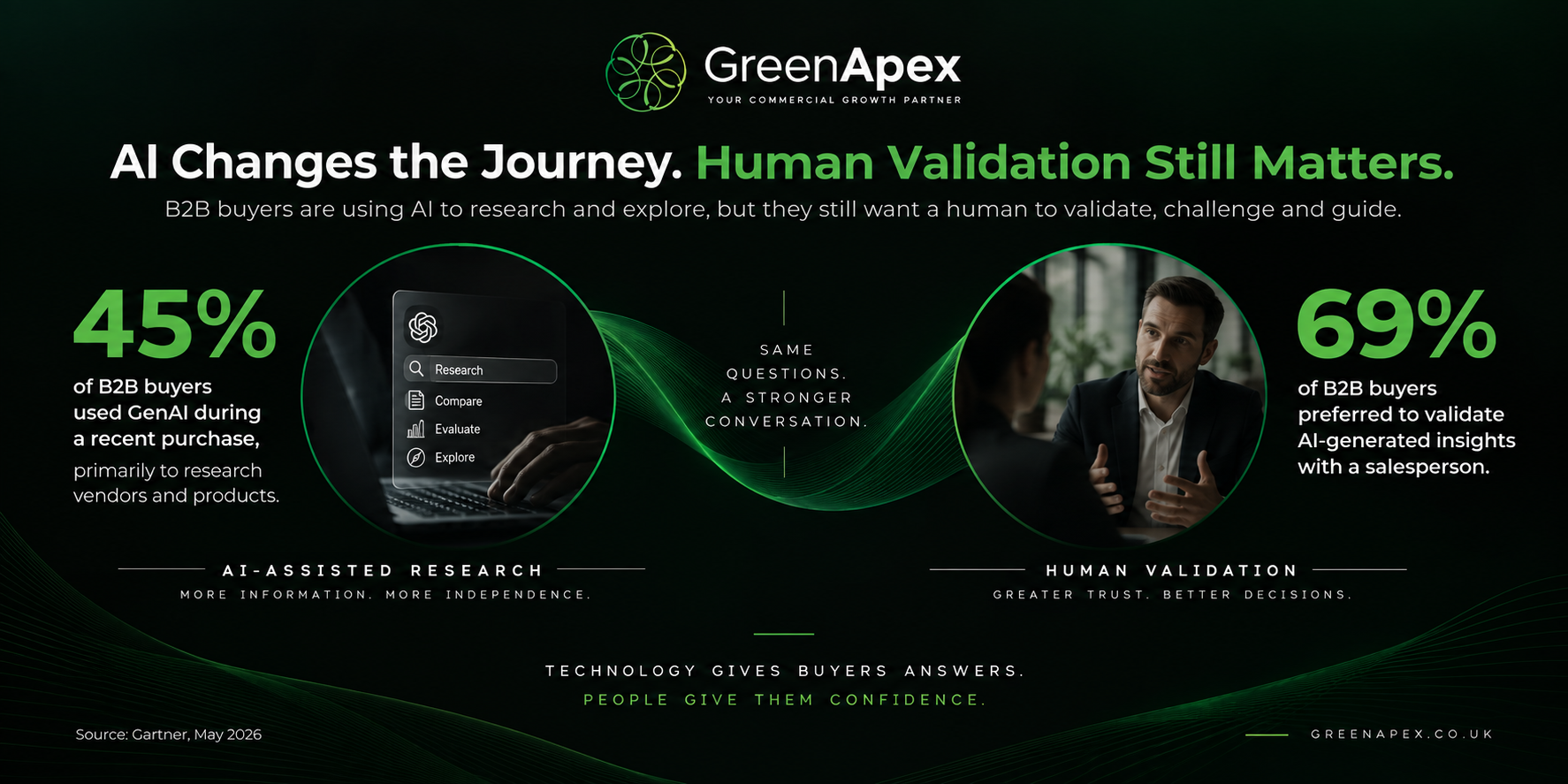
Gartner, May 2026. The data reinforces a key point: AI can support independent research without removing the need for human confidence and validation.
Sales is not disappearing, but its value is shifting. If buyers have already researched the category and compared suppliers, repeating information adds little. Sales needs to interpret, challenge and reduce uncertainty; marketing creates visibility and credibility. GTM strategy connects the two.
What is a Go-to-Market Strategy?
Go-to-market is often reduced to a launch plan, a marketing campaign or a sales sequence. In reality, a GTM strategy is the set of commercial choices that determines how a business takes an offer to a chosen market and turns interest into sustainable revenue.
It connects market opportunity to the ideal customer, problem, proposition, positioning, route-to-market, channels, sales motion and measurement. Those decisions are linked, so the choices made at the start shape everything that follows.
MARKET -> ICP -> PROBLEM -> POSITIONING -> CHANNELS -> MARKETING -> SALES -> CUSTOMER -> MEASUREMENT
If the ICP is too broad, automation creates more low-quality activity. If positioning is weak, more content only amplifies a message that still fails to resonate. If the route-to-market is wrong, an efficient sales process can still struggle to convert.
AI can accelerate activity. It cannot create direction.
AI is excellent at the work around a GTM strategy: research, market analysis, content, personalised outreach, CRM enrichment and signal detection. What it cannot own is the judgement behind which market to pursue, which segment matters most, why the offer should win or whether the route-to-market should be direct or partner-led.
A lesson from European expansion
In my previous work supporting North American companies expanding into Europe, the hardest question was rarely how many prospects we could reach. It was where the real opportunity was, whether to sell direct or through partners, who influenced the decision and which part of the proposition would resonate locally.
Take a specialist manufacturer considering Germany. AI can identify accounts, competitors and decision-makers, translate collateral and draft outreach quickly. Useful - but it still cannot decide whether Germany is the right priority or what proof the market expects. Get those choices wrong and AI scales the wrong activity; get them right and it becomes a multiplier.
That is the difference between using AI as the strategy and using AI within a strategy. One hands over direction; the other uses technology to improve execution after the important commercial choices have been made.
Sales and Marketing are Becoming One Commercial System
Modern buying behaviour makes sales and marketing harder to separate. Marketing may shape a customer's view before sales knows the account is interested, while sales conversations generate intelligence that should feed back into positioning, messaging and content.
Objections, competitor mentions, stalled opportunities and customer language are market intelligence. AI can help capture and analyse those signals, but people still have to decide what they mean and how the strategy should respond.
MARKETING
Gets you discovered
SALES
Builds confidence
GTM STRATEGY
Makes sure both are aimed at the right opportunity
That creates a connected commercial system: marketing builds visibility and relevance, sales creates dialogue and confidence, customer insight improves the next round of activity, and GTM strategy keeps everything focused on the same opportunity.
How We Use AI at GreenApex
We use AI every day at GreenApex to challenge ideas, analyse markets, explore options, research industries and pressure-test assumptions. For a small commercial consultancy, it lets us process more information and test ideas far faster than would otherwise be practical.
That does not mean I ask AI for a strategy and accept the answer. I give it context, explain the objective, challenge recommendations, ask why, explore alternatives and independently validate important information. The final commercial decision remains human.
Good strategy is not created by combining enough data points. It needs context, experience and an understanding of the founder, team, customer and market.
As automation grows, being human matters more
The more companies use AI for content and outreach, the easier it becomes for everyone to sound the same: the same polished email, LinkedIn post and supposedly personalised follow-up.
That is where I think the human side of B2B becomes more valuable. AI can help us understand an account before a call, but it cannot build the relationship. It can prepare a proposal, but it cannot read the room or earn trust.
The answer is not to reject automation. It is to be deliberate about where technology creates leverage and where a person creates more value.
Use AI to research the prospect - but understand the context before you call.
Use AI to prepare the proposal - but listen properly in the meeting.
Use AI to analyse the market - but challenge what it tells you.
Use AI to improve your marketing - but do not automate away the personality that makes people care.
The strongest model is not human versus AI. It is human judgement supported by better information, faster analysis and more efficient execution.
Before you automate your GTM, answer these seven questions
Before investing heavily in another platform, agent or automation, a business should be able to answer seven basic commercial questions clearly:
WHO - Exactly who are we targeting - and who are we deliberately not targeting?
WHY - What problem matters enough for that customer to act?
WHAT - What is our proposition, and why should the customer choose us over the alternatives?
WHERE - Which markets, channels and routes-to-market give us the best chance of winning?
HOW - How should marketing, sales and customer experience work together?
WHEN - Which signals tell us a buyer is ready for more direct human engagement?
WHAT EVIDENCE - Which measures tell us whether the strategy is genuinely creating revenue rather than simply creating activity?
Technology can improve the processes behind those questions, but it should not be responsible for deciding the answers. If a business cannot clearly explain its target customer, proposition, route-to-market and commercial priorities, another layer of automation is unlikely to be the first problem to solve.
“AI can make your go-to-market strategy faster, more informed and more efficient. It cannot replace human judgement. In an AI world, being human might become your greatest competitive advantage”.
Planning Your Next Market Move?
If you are entering the UK, expanding into Europe or assessing a new market opportunity, ExpandSmart™ helps you make the commercial decisions that need to come before execution.
From market analysis and positioning to route-to-market, partner strategy, sales development and execution, GreenApex helps turn expansion plans into a clear, practical GTM strategy.
Don’t accelerate the wrong strategy. Build the right one first.

Written by Daniel Greenfield - Founder & Managing Director at GreenApex
Daniel’s background spans international sales, commercial strategy and European market expansion. He has supported North American businesses entering and growing across Europe, developing go-to-market strategies, identifying market opportunities, building distribution and partner channels, and driving business development across multiple sectors.
Sources & Further Reading
• Gartner - 69% of B2B Buyers Turn to Sales Reps to Validate AI-Generated Insights (20 May 2026)
• Forrester - B2B Marketing Is Moving Faster Than Its Foundations Can Handle (5 August 2026)
• HubSpot UNBOUND - State of HubSpot 2026: How The Best Do It Differently (16 September 2026)
• HubSpot UNBOUND - AI: A New Marketing Channel in a Changing Consumer Journey (17 September 2026)
• HubSpot UNBOUND - How AEO Has Changed the Marketing Playbook (16 September 2026)
• HubSpot UNBOUND - The New GTM Engine for the Modern Business (18 September 2026)
• HubSpot UNBOUND - Human-Centered Marketing in the Age of AI (UNBOUND 2026)